[image credit: Forestry and Land Scotland]
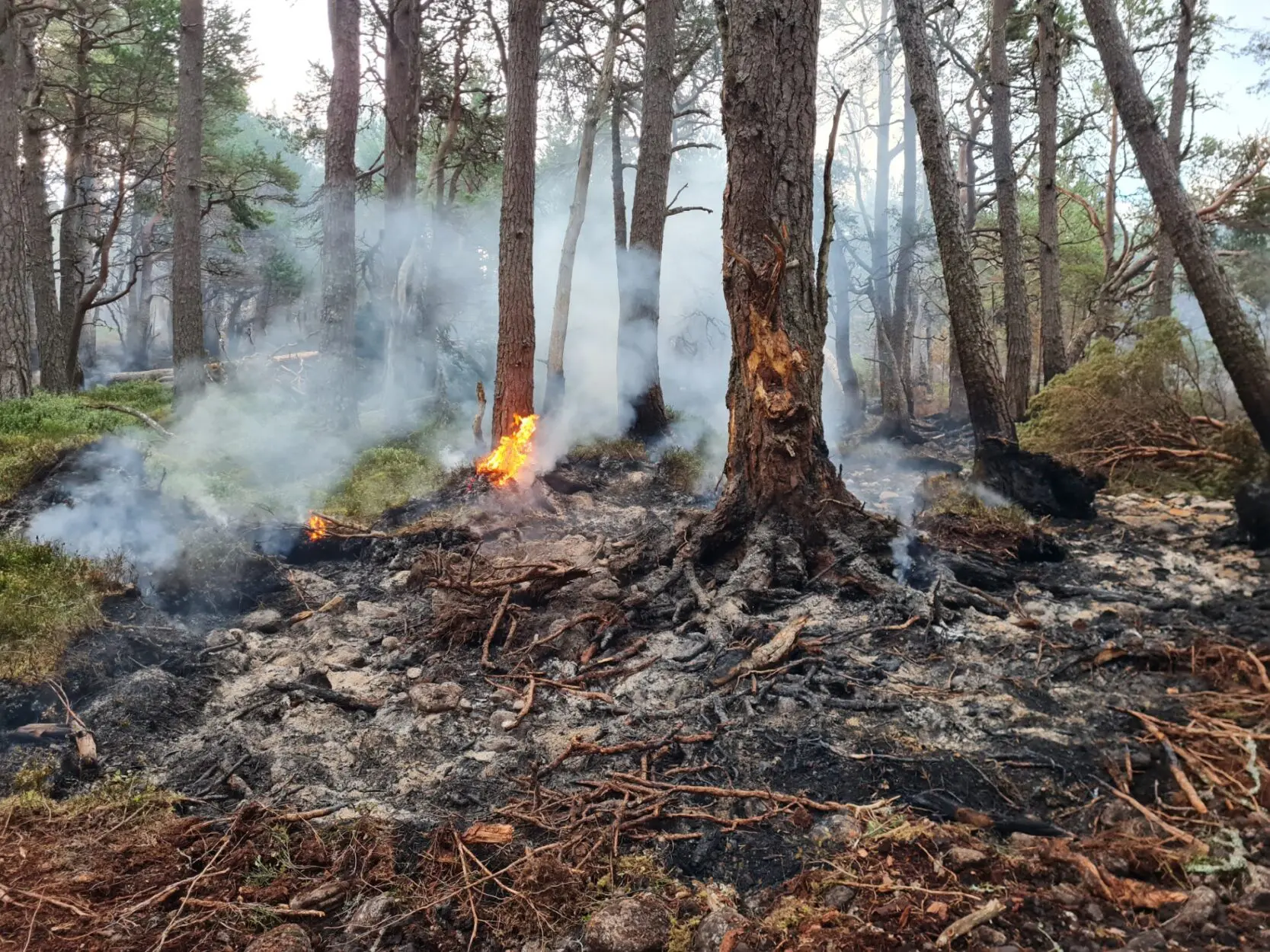
The Cairngorms wildfire that saw residents evacuated and ancient Caledonian pinewood damaged in recent weeks is continuing to smoulder and still at risk of reigniting, according to those on the ground. With the incident now largely out of the headlines, this week the RSFS has been hearing directly from the RSPB’s area manager about how the fire spread, how staff and community responded, the latest situation and how management of the reserve might have to change in the future.
Dan Tomes, South Highland Area Manager for the RSPB, had just returned from a well-earned short break after ‘working non-stop’ since the start of the Cairngorms wildfire on 15 July.
Speaking to the RSFS on Monday 3 August, he provided a stark description of the fire’s spread, the damage done to the Caledonian pinewood and an account of how firebreaks may have to be rethought in the future.
The main area of the RSPB’s Abernethy reserve initially affected by the blaze was open ground, he recounted, but after 10 days a particularly dry spell and strong southerly winds pushed the fire to burn moss on the already burned ground. This allowed the fire to connect with green vegetation, then burn into regeneration, and ultimately hit parts of the ancient Caledonian forest remnant ‘with quite a bit of force’.
On hitting the forest, Dan explained, the fire slowed down – but it then ‘got very hot and entered the ground’. Needles on the forest floor, and soil, ignited, allowing the fire to burn through root systems of big pine trees.
‘Fire creeps up the roots of granny pines, finds deadwood and burns from inside out, and then there can be a flare-up around the root plate.’
At this point, the team responding had to fell those trees near the track, as they were blocking access for the Scottish Fire and Rescue Service and RSPB staff. There was still now a possibility of having to fell more trees near tracks where they may be unstable and present a danger to the public.
Two notable areas of the ancient pinewood damaged by the fire are Carn a' Chnuic (grid reference NJ045145), which was ‘extensively impacted’ and the ‘really beautiful’ Ice Woods (NJ020130). Another area west of the Ice Woods, a former 1980s plantation ploughed into peat, had seen the peat has caught fire as well as young trees, setting back an area that had been seeing interesting biodiversity developing, including black grouse lekking this spring. Additionally, there were ‘still a few flare-ups on open ground well out of the forest near the Munros’.
When the RSFS spoke with Dan, areas were still smouldering, creating an ongoing risk of a further flare-up. He explained: ‘It can creep up and catch, and if no one is there and if the wind gets up it can catch fire.’
On Monday this week, helicopters were still being used to waterbomb the area, while portable dams with pumps were being used to put out hotspots with hoses. The fire service was still on site, with nine appliances between Glen More – where the Green Lochan area saw pinewood burned – and Abernethy.
As well as firefighters and the RSPB, neighbouring estates also had staff and resources participating in the effort. Dan described the ongoing task: ‘The work involves getting teams out to the right place, keeping them safe and getting them back again. Rinse and repeat. A few people are out walking the black line of fire to measure its extent. We will be doing the same past this weekend, and hoping for heavy rain. It is an ongoing assess-and-treat process. SFRS will be here another couple of weeks, RSPB another month or two.’
What would this situation – and the apparent new normal of heightened wildfire risk due to global heating – mean for management of this important habitat?
‘In terms of what’s next for forest design, we’ll have to see’, Dan said. ‘We had to do extreme things to protect [the village of] Nethy Bridge – a wayleave was bulldozed down to the gravel as a firebreak, an eight- to ten-metre strip that had been open ground with regen. In the past, tracks would have acted as an effective firebreak, but as the forest regenerates, that’s not the case. We will have to reassess going forward.’
Asked about the area’s prospects for recovery, Dan said: ‘It is well within the Cairngorms Connect restoration area, where deer numbers are low, so there should be a lot of regeneration – we hope with lots of broadleaf, as Nethy is low on broadleaf. For damaged trees, some have had their lower branches scorched and browned, but the upper canopy remains green, so we hope they survive. Other trees have been completely torched.’
But for now, attention was necessarily focused on the immediate task in hand of containing the problem: ‘We are all exhausted. A lot of people have been working crazy hours. But the effort from the fire service, the local community, neighbouring estates and the RSPB has been huge.
‘It’s not over yet. This is day 20, and there are at least another 20 yet, and maybe a lot longer.’
Gavin McGregor