Introduction and Context
Managing deer is obviously central to successful management and regeneration of woodlands, but the economics of making this work can be very difficult.
Recognizing this, in 2024-25, Nature Scot introduced a trial deer cull incentivization scheme, paying £70 head for numbers of hinds and calves (or does/ kids) above a baseline cull level. The areas concerned were the Cairngorms National Park, focused on red deer, an area of Central Scotland, focused on roe deer, and the south side of Loch Ness, focused on sika deer.
The outcome was mixed. In 2025-26, these schemes have been repeated, with a higher price of £100 per animal. The Loch Lomond and Trossachs National Park introduced a scheme this season as well. These trial areas are well known and we will get a review in due course.
Less well known is the situation in the Sunart area to the west of Fort William, where a successful application to the Rainforest Restoration Fund for oak woodland restoration included a sum of money that could be used for its own bespoke cull incentive scheme. The purpose of this article is to set out how this scheme worked, and why it should be held up as a project that should be able to inform the deer/ woodland debate at a national level. It is particularly relevant because all of the properties involved are small and medium sized, including crofted land and community ownership, and the situation is therefore more representative of the country as a whole.
The Sunart Rainforest Area
The project area covers the area of SSSI and SAC designated oak woodland lying along Loch Sunart, between Strontian and Salen. There are multiple small- medium sized properties, with private owners, and crofting and community tenure, as well as woods managed by Forestry & Land Scotland.
By 2026, deer numbers in the wider Sunart area were counted by drone to be just over 10 per sq km, too high for oak regeneration. Some retrospective population modelling over an area which included adjacent FLS managed plantations suggested the population might be higher, possibly 13-17 deer per sq km. Woodland HIA in the oak woods suggested this could well be right.
Any new attempt to restore the oak woodland had to address the grazing pressure. Nature Scot were unwilling to fund repair or maintenance of the fence. Some owners felt it was not practical either. We looked at a deer control solution over a wider area.
Nature Scot did not specify the terms and conditions of an incentive scheme in Sunart, but the aim was to incentivise and verify additional deer management activity.
The actual Sunart Rainforest area was 8000 ha. However, it was considered that an additional area of land, largely occupied by FLS, would have a material impact on the outcomes.
Terms & Conditions
- The scheme was open to anyone who had legal authority to shoot deer within the project area. Public land was largely excluded.
- Hinds and red deer calves were the main target of the scheme
- The money paid out was £150 per head of red deer and £100 per head of roe deer, above a 5- year average cull for each property/ controller.
- The £150 is significantly more than other incentive schemes, but it is in line with contractor rates on the west coast in similar terrain.
- Data was verified by Epicollect5, which was very easy and intuitive for people to use.
- The budget was £40,000. A proportion of which was subject to VAT.
- In summary, the incentivized cull was almost five times that of the previous average.
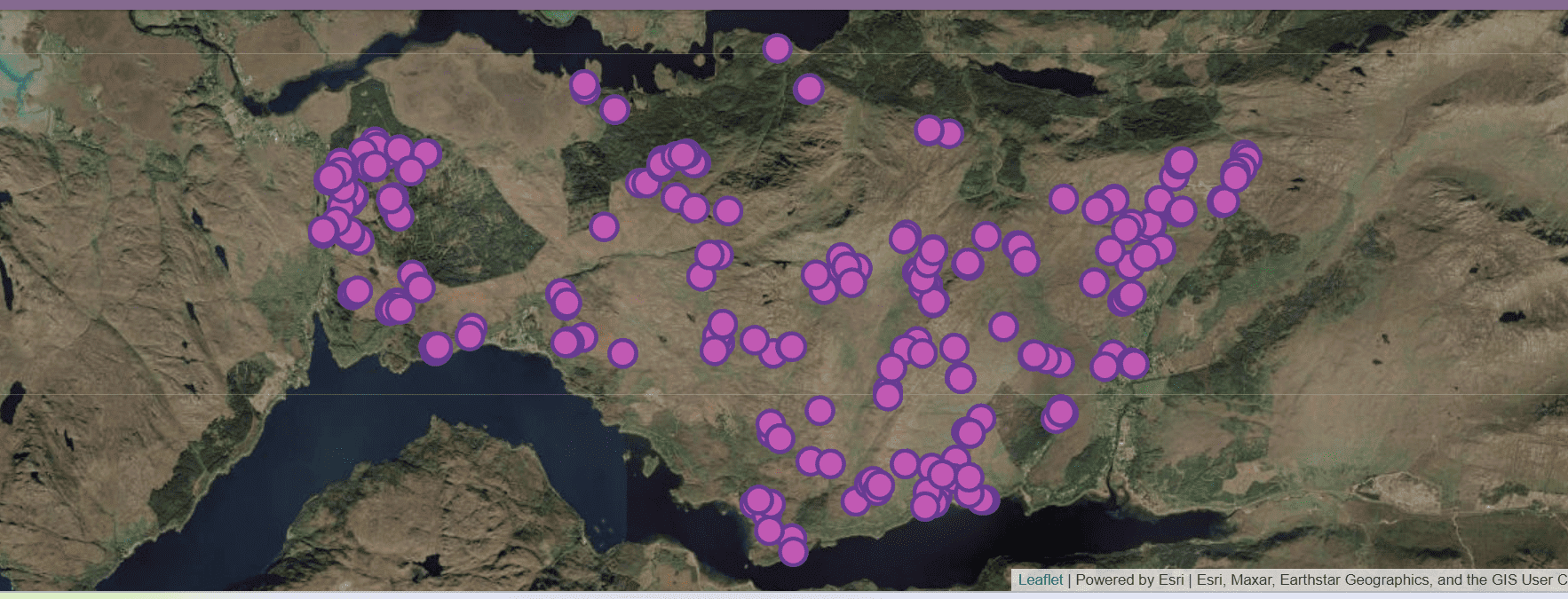
- As can be seen from the image below, culls where well distributed throughout the project area.
Results
| 2025-26 Season Summary | Stags | Hinds | Calves | Roe | TOTAL |
| Total Incentivized cull- minus FLS | 106 | 203 | 99 | 16 | 424 |
| FLS (ALL) | 184 | 137 | 79 | 13 | 413 |
| TOTAL: | 290 | 340 | 178 | 29 | 837 |
| Stags | Hinds | Calves | Roe | TOTAL | |
| Previous non incentivized cull | 65 | 48 | 14 | 4 | 131 |
| FLS 5 year average | 181 | 113 | 64 | 20 | 378 |
| Total: | 246 | 161 | 78 | 24 | 509 |
| DIFFERENCE (5 year average) | 44 | 179 | 100 | 5 | 328 |
| Suggested Target | 350 | 350 | 140 | ||
| Difference | -60 | -10 | 38 | -32 |
In total, 837 animals were culled within the overall area, split 50:50 between FLS and the incentivized properties. Most of these animals were red deer. The incentivized properties increased their deer cull from 131 to 424 over their 5- year average. The cull of hinds and calves was just under five times the previous average.
Importantly, despite the much higher cull on adjacent ground, FLS were able to maintain their numbers, with a modest increase.
Our analysis of the deer population in Sunart, based on incomplete evidence, suggested that an annual cull of 300-350 stags and 300-350 hinds would be required to reduce the population over three years. So, although the overall cull was a bit below the high end of this range, the outcome has been a good one, and these culls must surely now be reducing the population. What is needed now is funds to repeat the exercise, and keep it going for ten years or so.
This is a summary version of a longer article which will appear in the summer edition of the Scottish Forestry journal. The full article, available as a PDF, will be linked here at that point.
The Sunart Rainforest Deer Management Plan, and the various deliberations around that, can be found at this link: https://sunartcommunitycompany.co.uk/sunart-rainforest/sunart-rainforest-deer-management-plan
Victor Clements is a woodland and deer advisor living and working in Highland Perthshire. As part of The Native Woods Co-operative (Scotland) Ltd, he has supported the Sunart Community Company in developing a deer management plan to help take forward their restoration objectives in the oak woodlands, hopefully with benefits for the adjacent National Forest Estate land as well.
Euan Palmer was the project co-ordinator, and supported those using the cull incentive trial and Epicollect.
Victor will be presenting a case study of the research at the Forest Research x RSFS event on 11 June on Deer Management and Crop Protection. Tickets are available.
The views expressed in our RSFS member’s blog posts are those of the author and do not necessarily reflect the views, opinions, or positions of RSFS, any organisation, employer, or affiliated institution.