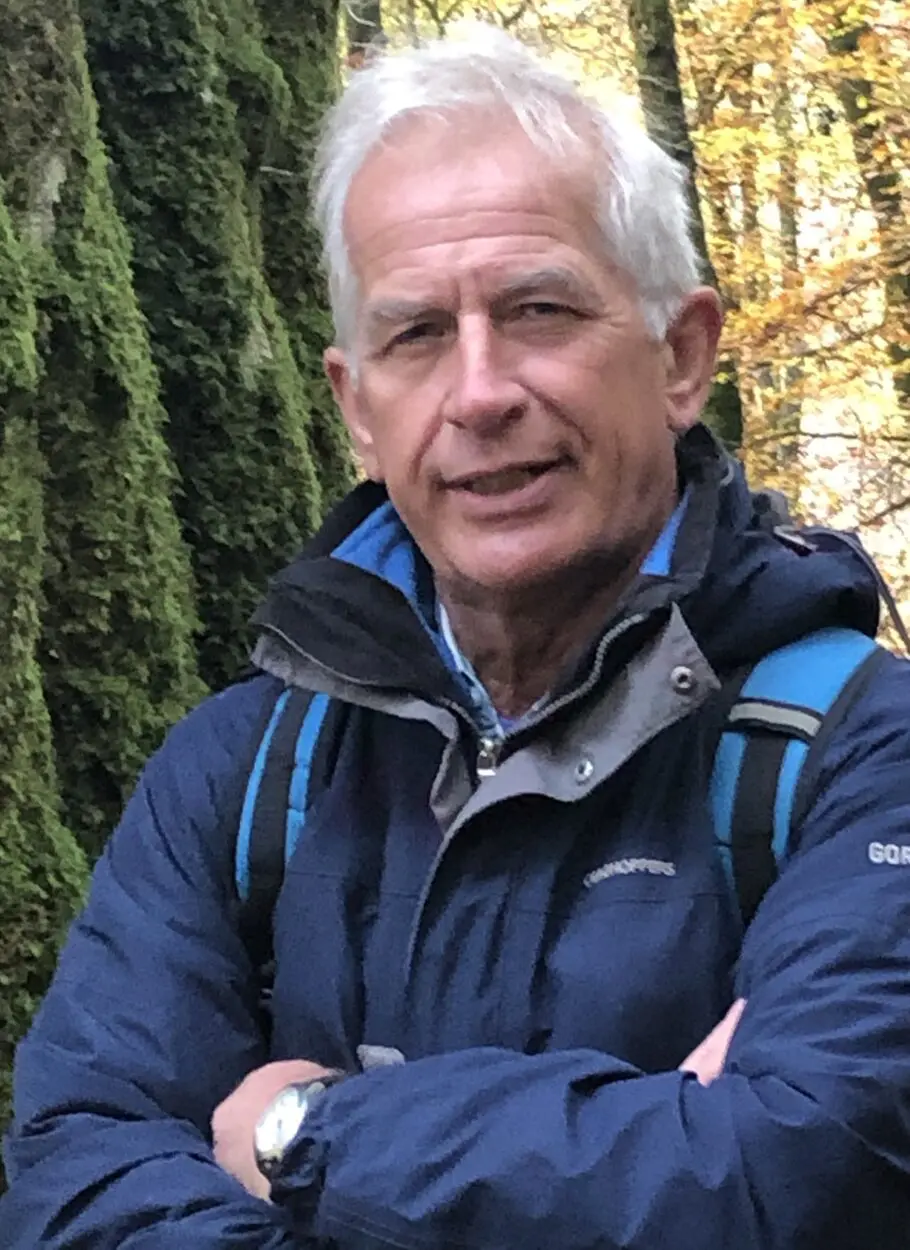
What made you become a member of RSFS?
I joined just after leaving University and joining the Forestry Commission in 1978. Many other FC staff were members and encouraged me to join in order to meet other forestry-minded folk and network with them. That was sound advice! I found myself meeting a diverse group with varying opinions (and ready to argue on all and sundry) but very welcoming to young forester
Where did your interest in forestry begin?
I come from Gourock on the River Clyde, so I wasn’t born into a rural environment or a link to forestry management, something I discovered wasn’t unusual for many forestry professionals After school, I went to Edinburgh University in 1974 to study Ecological Science because of some vague notion about a ‘worthy’ desire to do some thing to help ‘save’ the environment. Edinburgh University was the only University at the time offering a degree in Ecological Science. They also had a good rugby team (very important then) in one of the most attractive and historic city settings. By sheer good fortune (serendipity?), the Ecological Science degree had been established out of an original forestry degree. When I was introduced to the forestry/woodland aspects and practical land management based on sound scientific principles, I much enjoyed it. A summer placement on Atholl Estate in beautiful Perthshire gave me a further taste of what life might be like working in forestry so, on graduating, I joined the FC as an assistant District Officer. The lesson out of this good fortune was to always seek new experiences and opportunities because you never know which might be the right one for you!
What’s your involvement with forestry now?
I’ve been retired for 10 years and have undertaken a number of pro bono involvements because basically I still enjoy walking around woodlands and contributing, if asked, to how they might be managed positively. More specifically, I still act as judge for Scotland’s Finest Woodland Awards, help mentor local community groups via the Community Woodlands Association, and get involved in ad hoc advisory work on such diverse subjects as advising my local golf club on managing their woods as well as leading short tours in Perthshire on the history of the ‘Big Trees’ in that area and the people associated with them. So, yes, still involved but in a more relaxed manner!
Where is a great place in Scotland that not everyone knows about?
There are so many great places in Scotland though many of them are well recognised as evidenced by the growing numbers of tourists. Glen Lyon in Perthshire however, despite being a historic and ancient landscape, is rather under-visited in my opinion though those who do, appreciate its worth. I love the contrast of interesting subjects such as the Fortingall Yew, ancient pinewoods at Meggernie, in a constantly evolving landscape dressed with brand new woodlands.
Do you have a favourite tree and why?
I am not sure if I have a favourite tree as such because there are so many wonderful specimens, both native and introduced, that we are fortunate enough to be able to grow in Scotland but if I had to choose one it would probably one of the original Douglas firs introduced via seed sent back from the Pacific Northwest by David Douglas which arrived in Britain in 1827. There are many locations where you can still some of these originals including Scone Palace and Dunkeld Cathedral in Perthshire, and Dawyck Gardens, in the Borders. I suppose it’s the combination of these majestic trees, now nearly 200 years old and amongst the tallest trees in Europe, allied to the endeavours of David Douglas, an enterprising and rugged Scot, that makes these trees so appealing in my eyes.
Can you give us a book, film, TV show or podcast recommendation? It doesn’t have to be forestry related!
I remember watching a documentary called ‘The Greatest Good’ produced on the centenary of the US Forest Service in 2005 and thought it was a wonderful evocation of a state forest service and the role of foresters in managing forests on behalf of the public good (you can see a trailer for this on YouTube). It also outlined the vision of the driving force behind the USFS, Gifford Pinchot, who defined conservation as the management of natural resources ‘for the greatest good to the greatest number of people for the longest period of time’ which actually rather suits our circumstances in Scotland, in my opinion. The political vicissitudes under which the US Forest Service still has to operate today (especially today!) is a reminder of the need for long-term stable forest management and not short-term expedience.
I would also recommend the book ‘The Cone Gatherers’ by Robin Jenkins as an interesting insight into the early days of the FC in Argyll as well as a good old fashioned morality tale!
What do you think is an important issue in forestry today?
I’m probably a little out of the loop in terms of current forestry challenges but inevitably attracting enough individuals into forestry practice and management remains a significant challenge to delivering optimal outcomes from the forests being established and managed. For some reason, folk who love the idea of conservation and woodland restoration, don’t follow through onto the wider range of forestry management. I wish it were different…Good forest managers are key to the long-term success of Scottish forestry. We neglect that resource at our peril.
Outside of forestry, what is a hobby or activity you enjoy?
I play golf and tennis regularly, garden with enthusiasm if sub-optimal outcomes, still walk regularly in the great outdoors, and regularly assault my favourite bit of Sitka spruce timber, which is a Martin acoustic guitar, to play Scottish folksongs accompanying my wife, Nicky, as part of PlaidSong. However, the most enjoyable activity is being with my grandchildren, who make no allowances for age, infirmity or ability!
What was your first job?
My first job was delivering newspapers when I was in primary school and which I look back on relatively fondly. I can’t imagine my grandchildren ever being persuaded to do that! My first forestry job was on Atholl Estates in Perthshire helping compile an updated inventory. Funnily enough, the archivist at Atholl Estate, who lives locally, handed me a copy of that original report from1977 some 45 years later!
What do you love most about forests or forestry?
I think it is the sense of being involved in something that encompasses so many facets (timber, conservation, recreation, landscape, and history) and has sense of rhythm both annually and perennially. Touching a tree that was alive when the Romans walked in Scotland (the Fortingall Yew) or which David Douglas collected 200 years ago at the mouth of the Columbia River in Washington State still gives me the ‘wow!’ factor.